Attracting Beneficial Bugs
Attracting Beneficial Bugs to Your Backyard - A Book Review
By Kim Davis
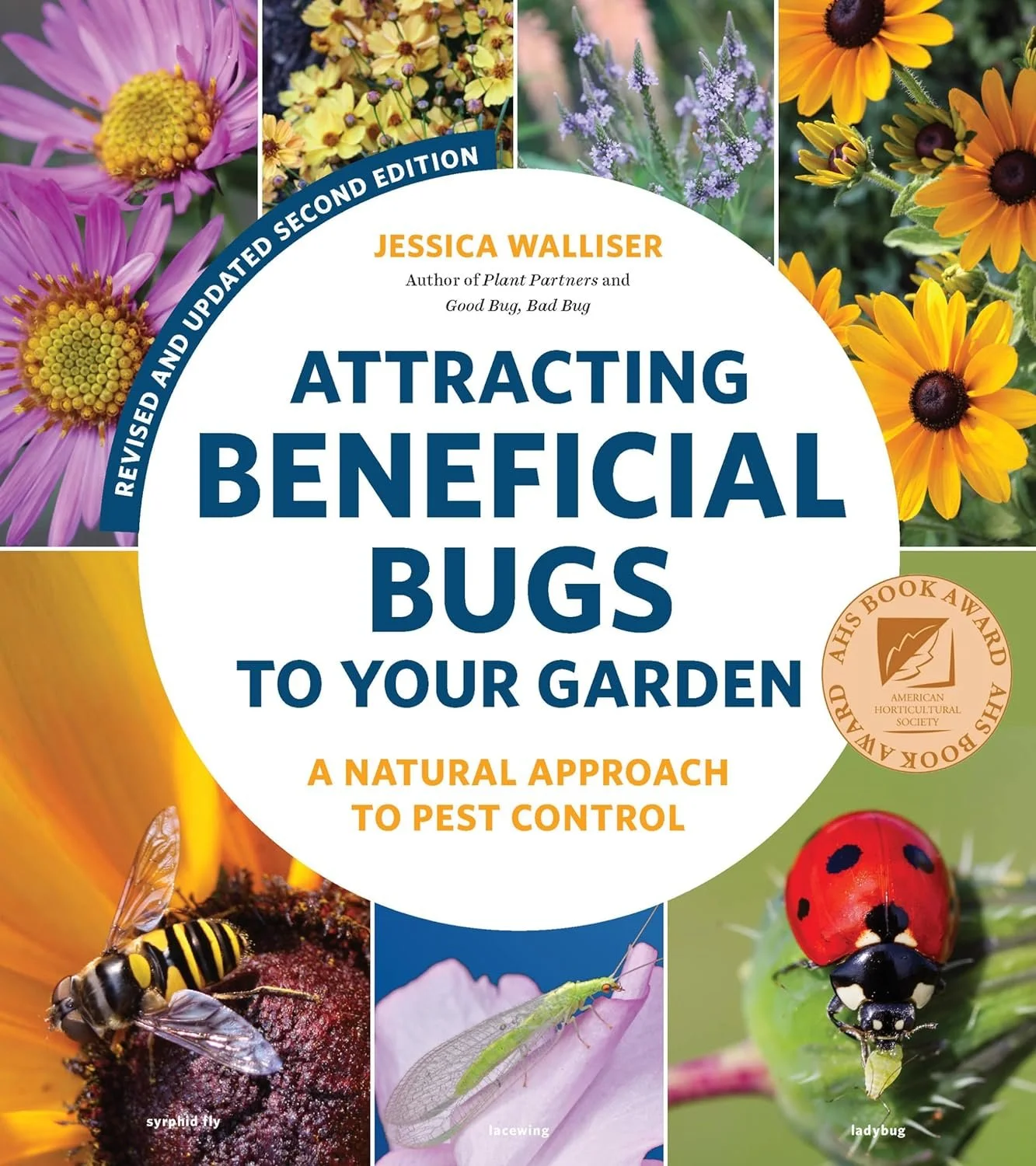
Early last spring, the grasshoppers came for my plants. I was worried until about a week later when the jumping spiders arrived and saved my garden from the voracious appetites of the Orthopterans. I was pleased to see integrated pest management in action and vowed to double my efforts to attract more beneficial insects this season. Attracting Beneficial Bugs to Your Garden: A Natural Approach to Pest Control by Jessica Walliser serves as a valuable resource and will help gardeners like me achieve this goal. The author writes from the perspective of a gardener who learned to love the insects that visit her gardens.
Chapter 1 lays out the scientific basis for a natural approach to integrated pest management. Walliser describes bug taxonomy and the complex food web that happens right under our noses. She never loses the perspective that comes from someone who grew to appreciate the beneficial insects she observed in her garden. Her description of the roles of predator and prey on pages 1619 give us confidence in our predator friends. Chapter 2 profiles the beneficial insects that we want to attract to our gardens. Each profile is accompanied by detailed pictures of these insects and suggestions for the plants we can use to attract them. It should be noted that some plant species are not well-suited to our semi-arid steppe and its cold winters.
Chapter 3 delves into the relationship between plants and insects to help us understand the ways in which pollen and nectar attract and support beneficial insects or the insects upon which the beneficials prey. Pages 85-88 provide a discussion on insect mouthparts and how to plan for the types of plants that will support the feeding needs of different insects. I found it an inspiration for planning a garden to attract and support beneficial insects. Further inspiration is found in Chapter 5, which contains tips that allow us to design insectary borders and strips for our gardens. This chapter, as well as Chapter 6, is especially useful for vegetable and herb gardeners, and Walliser argues that native species and companion planting in our food gardens are wonderful methods for managing dreaded pests like aphids or tomato hornworms.
Walliser gives us a clear path to the elimination of pesticides to protect our precious pollinators. She advocates for patience, encouraging gardeners to resist immediately reaching for any treatments including mechanical removal. She asks us to trust that we have provided for the myriad of beneficials that will help us keep our gardens in balance. She successfully weaves scientific terminology with lived experience to remind us that we really should not plant just for ourselves but also the insects that live alongside us and depend on our gardens for life.